

Chapter 01
The Questions Nobody Thinks to Ask a Lawyer
Most people arrive at a superannuation splitting conversation already behind. They have spent months negotiating a property settlement without including super in the pool. Or they have agreed to a split they think is fair, only to discover that the balance sitting in their ex-partner's industry fund is larger than the house deposit.
The questions people actually have about superannuation splitting in Australia are specific, practical, and often a little embarrassing. Nobody wants to ask their lawyer whether they can spend the super next week, or whether an SMSF their ex controls is real.
These questions have real answers. Here they are.
Do I actually have to include superannuation in the settlement?
No. Superannuation splitting is not mandatory under Australian family law. Both parties can agree to leave superannuation out of the settlement entirely. But choosing to leave it out is a decision with consequences, and it should be a deliberate one, not an oversight.
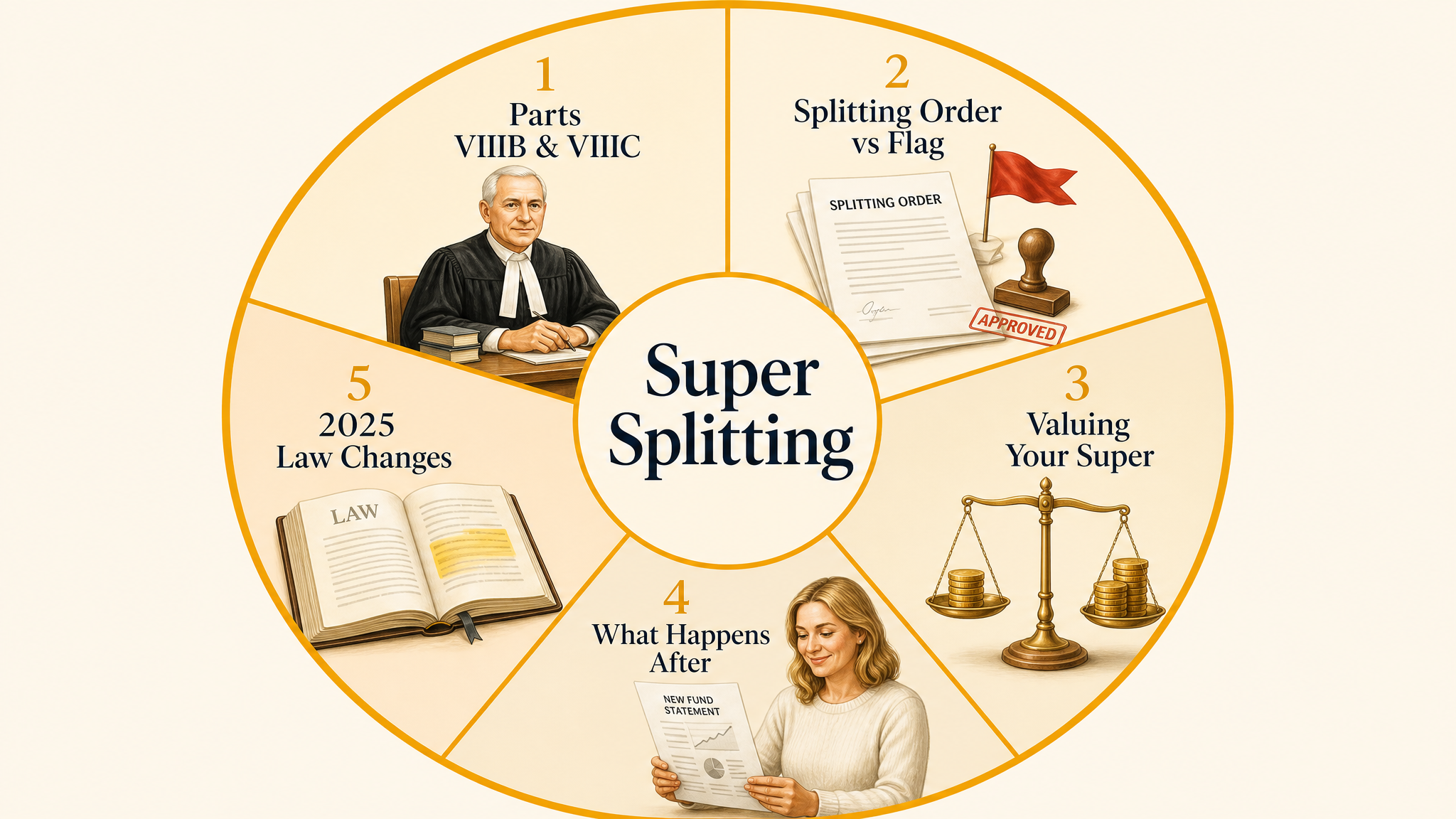
Superannuation is treated as property under the Family Law Act 1975 (Cth). Under Parts VIIIB and VIIIC of the Act, courts have the power to make orders splitting superannuation interests between parties. If you do not address it, the default is that each person keeps their own super, regardless of the disparity in balances.
For many couples, particularly those where one partner worked part-time or stepped back from paid employment to raise children, the superannuation gap is one of the most significant financial inequalities in the relationship. Agreeing to leave it out without understanding its value means accepting an outcome you may not have chosen with full information.

Chapter 02
How Much of My Ex's Super Am I Entitled To?
There is no automatic percentage. The court does not divide superannuation 50/50 as a starting point any more than it divides other assets that way.
Superannuation is assessed as part of the overall property pool under the four-step framework in s 79 of the Family Law Act 1975 (Cth). The court identifies and values all assets including super, assesses contributions, considers future needs, and determines a just and equitable outcome. Super is then addressed as part of that overall result, either through a splitting order or by adjusting the division of other assets to account for the super disparity.
In practice, this means the percentage of super you may be entitled to depends on the length of the relationship, the relative superannuation balances, the contributions each party made, and the future needs of each person. A primary carer who stepped back from paid work for many years will typically have a stronger claim on their partner's super, particularly if their own balance is substantially lower.
The question of entitlement is also complicated by the type of super interest involved. Accumulation funds, defined benefit funds, and pension-phase interests are all treated differently under the Family Law (Superannuation) Regulations 2025, which commenced on 1 April 2025 and replaced the 2001 Regulations. Each type has its own valuation method, and the differences matter.
Chapter 03
How Is Superannuation Valued for Family Law Purposes?
Accumulation funds are the simplest. The value is the account balance at the relevant date, as certified by the trustee. You can request this information directly from the fund under the information-sharing provisions in the Family Law (Superannuation) Regulations 2025.
Defined benefit funds are more complex. The value is not simply the account balance — it is a calculated figure based on the member's entitlement at a future condition of release, discounted to a present value using actuarial assumptions. The 2025 Regulations updated the demographic and economic assumptions used in these calculations, which affects the valuation of defined benefit interests negotiated after 1 April 2025.
Pension-phase interests, where the member is already drawing an income stream, require separate consideration depending on whether the pension is reversionary and what the fund's rules permit.
Self-managed superannuation funds are an exception. The Regulations do not prescribe a standard valuation method for SMSFs. Valuation typically requires an independent accountant or financial adviser and involves assessing the underlying assets of the fund, which may include property, shares, or private investments. This is where valuations can become contested.
Chapter 04
What Is a Payment Flag and When Is It Used?
A payment flag is a type of injunction placed on a superannuation interest. Under Part VIIIB of the Family Law Act 1975 (Cth), a flagging order prevents the trustee from making any payment or transfer from the interest while the flag is in place. The fund is effectively frozen pending a final resolution.
Flags are used when the parties have not yet finalised what to do with a superannuation interest but need to preserve it in the meantime. They are particularly useful when a member is close to retirement and might otherwise access or commute the super before a settlement is reached.
A flag does not divide the interest. It simply preserves it. Once the parties reach a final agreement or the court makes a final order, the flag is lifted and replaced by a splitting order, or the parties agree to deal with it another way.
To obtain a flagging order, the applicant must serve the trustee of the relevant fund with the application at the time of filing. The trustee has the right to appear at any hearing relating to the flagging order.
Chapter 05
What Is a Splitting Order and What Actually Happens to the Money?
A splitting order is a court order that directs a superannuation trustee to divide a superannuation interest between the member spouse and the non-member spouse. It can specify either a dollar amount, known as the base amount, or a percentage of the splittable payment.
Once a splitting order is made, the trustee deducts the specified amount from the member's interest and establishes a separate entitlement for the non-member spouse. The non-member spouse then has a choice: keep the entitlement in a new account with the same fund, or roll it over to another eligible superannuation fund.
And here is the answer to the question almost everyone asks first: you cannot access that money as cash. The amount rolled over remains superannuation. It is subject to the same preservation rules as any other super balance. You can only access it once you satisfy a condition of release, which is almost always reaching your preservation age and retiring from paid work.
The practical effect is that a superannuation split does not improve your financial position today. It improves your retirement position. For many people going through separation, particularly those who sacrificed career and earning capacity to raise children, that future benefit is significant. But it does not pay the rent this month.
Chapter 06
My Ex Has a Self-Managed Super Fund. Is That Different?
Yes, and significantly so.
An SMSF is a superannuation fund with four or fewer members, typically controlled by the members themselves as trustees. If your ex is both a member and a trustee of an SMSF, they have direct control over the fund's investments, reporting, and administration.
This creates two distinct problems in a property settlement context. The first is valuation. Because the 2025 Regulations do not prescribe a standard method for valuing SMSF interests, the valuation must be done by an independent expert. If the SMSF holds illiquid assets such as property or private company shares, the valuation can be disputed and may take time.
The second problem is disclosure. An SMSF trustee has both the access and, in some cases, the motive to restructure the fund's investments or alter its records in ways that affect the apparent value of the interest. This is a recognised form of financial non-disclosure. Courts take it seriously.
If your ex controls an SMSF, you should obtain independent legal advice early and consider applying for orders requiring full financial disclosure of the fund's assets, transactions, and investment decisions going back at least two to three years.
Chapter 07
What If My Ex Is Hiding Superannuation?
It is more common than most people expect. Superannuation is one of the less visible financial assets in a relationship, and it is not unusual for one partner to have limited knowledge of the other's fund memberships, particularly in longer relationships where both parties worked in different industries.
The duty of financial disclosure under the Family Law Act 1975 (Cth) requires each party to disclose all superannuation interests, including any interest in a self-managed fund. Failure to disclose is a breach of that duty and can result in costs orders, adverse inferences at trial, or orders setting aside a settlement reached without proper disclosure.
You can take practical steps to identify undisclosed super. The Australian Taxation Office maintains the SuperMatch service, which allows individuals to search for superannuation accounts held in their own name. Through the Family Law disclosure process, you can request that your ex provide certified statements from every fund they are a member of. Your lawyer can also seek orders requiring the ATO or specific funds to provide information directly.
If you suspect deliberate concealment, that is a matter that goes beyond disclosure. It can affect the overall settlement outcome under the court's general equitable jurisdiction.
Chapter 08
What Changed in 2025 and Does It Affect My Case?
Two sets of changes affect superannuation splitting cases that commenced or are still on foot in 2025 and 2026.
First, the Family Law (Superannuation) Regulations 2025 commenced on 1 April 2025. These replaced the 2001 Regulations and updated the formulas and actuarial assumptions used to value defined benefit interests. If your case involves a defined benefit fund and was valued under the old Regulations, the valuation may need to be revisited. The 2025 Regulations also simplified certain procedural requirements and increased minimum thresholds for splitting to reflect inflation since 2001.
Second, the Family Law Amendment Act 2024 (Cth) introduced broader property reforms that took effect from 10 June 2025. These changes affect how courts assess the overall property settlement, including superannuation as part of the pool. The amendments require courts to consider the economic effect of family violence and financial abuse on each party's circumstances, which can affect the superannuation component of a settlement where one partner was financially controlled during the relationship.
Whether these changes apply to your case depends on when proceedings commenced and where the matter is currently at. If you are in the middle of a settlement negotiation or proceedings that started before 10 June 2025, the transitional rules determine which version of the law applies. Getting specific advice on the transitional rules before making any final decisions is important.
Chapter 09
Can We Just Agree to Leave Super Out of It?
Yes. As noted above, superannuation splitting is not mandatory. But if you are choosing to leave it out, that agreement should be documented properly.
An informal agreement to leave super alone, whether reached verbally or by email, is not binding under Australian family law. To properly finalise the superannuation position, you need either consent orders that address superannuation (even if they record that neither party is seeking a super split) or a Binding Financial Agreement under ss 90B, 90C, or 90D of the Family Law Act 1975 (Cth) that deals with super.
Without a formal instrument, either party can later return to the court and seek super splitting orders, provided they are within the applicable time limits. For married couples, the time limit for property and superannuation orders is 12 months from the date the divorce order takes effect. For de facto couples, it is two years from the date of separation. After those deadlines, you need the court's leave to proceed.
The time limits apply even if you think the matter is settled. An informal agreement does not stop the clock.
Chapter 10
What You Should Do With This Information
Superannuation is often the largest single asset in a separating couple's pool. Leaving it out of a settlement without understanding its value is one of the most common and costly mistakes in family law.
Naomi Pearce
Superannuation splitting is one of the areas of family law where the gap between what people assume and what the law provides is largest. People assume super cannot be touched. They assume an equal split is automatic. They assume the money will be available immediately. Almost none of that is correct.
What is correct is that superannuation is often the largest single asset in a separating couple's pool, that it can be divided under a well-established legal framework, that the framework was significantly updated in 2025, and that leaving it out of a settlement without understanding its value is one of the most common and most costly mistakes in family law.
At TFA Legal, we work with clients to make sure the full picture of the asset pool is on the table before any agreement is reached. That includes superannuation, including interests in self-managed funds, and including interests that the other party would prefer not to disclose. The 2025 changes to both the Regulations and the broader property framework mean that advice given even 12 months ago may not reflect the current law.
If you have questions about superannuation splitting in Australia, or if you are in the middle of a settlement and not sure whether super has been dealt with properly, the right time to find out is before you sign anything. Call us on 1300 322 295 or book a free consultation at tfalegal.com.au.
Appendix
Frequently Asked Questions
About the Author
Naomi Pearce
Senior Partner & Founder
LIV Accredited Specialist in Family Law, admitted in Victoria and Queensland. Naomi specialises in trauma-informed family violence representation and coercive control litigation.