

Chapter 01
Before We Start: Two Things You Need to Know
Australia has no-fault divorce. Under s 48 of the Family Law Act 1975 (Cth), the only ground for divorce is irretrievable breakdown of the marriage, proven by 12 months of separation with no reasonable likelihood of resuming married life. The court does not ask who left, who was unfaithful, who spent all the money, or who made the home unbearable. None of that is legally relevant to whether you get a divorce. This is liberating for many people. For others, particularly those who endured years of harm, it can feel like the law's indifference to what they survived. It is not. The divorce process and the property settlement process are separate. Your story gets told in the property proceedings, where the 2025 reforms have given it significant new legal weight.
Getting a divorce does not resolve your property or your parenting arrangements. Divorce is only the legal ending of the marriage. Property, superannuation, and arrangements for children are separate legal matters. There is a hard 12-month deadline after your divorce order takes effect within which you must apply to the court for property settlement. Missing that deadline is one of the most expensive mistakes clients make. It comes up again at the end of this article, and it matters more than most people realise.
Chapter 02
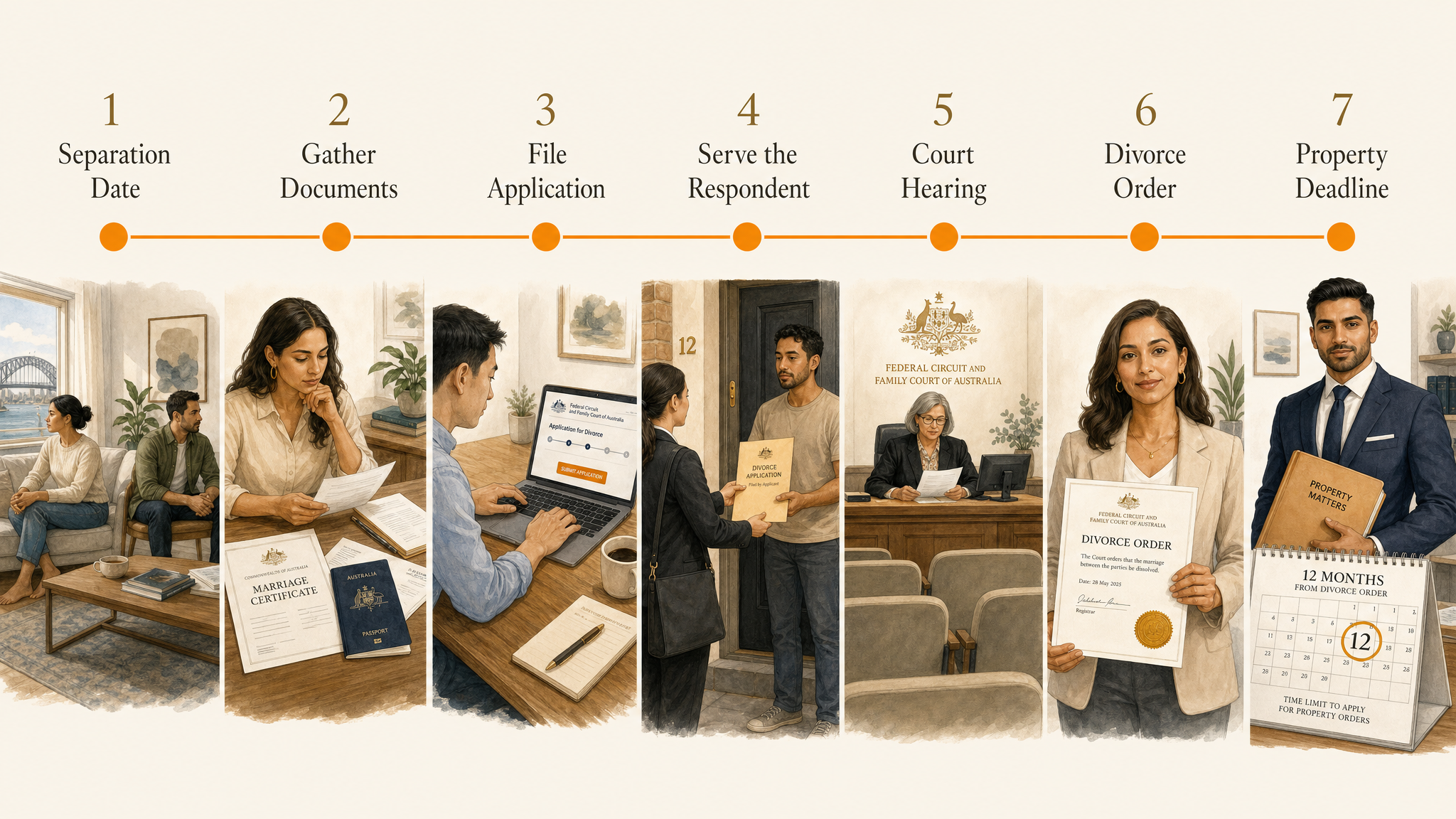
Stage 1: The Separation Date
The 12-month separation clock starts on the date you and your spouse separated. Under s 48(2) of the Family Law Act 1975 (Cth), you cannot file for divorce until 12 months and one day have elapsed from that date. There is no workaround and no way to shorten this.
You do not have to be living at different addresses. Section 49 of the Act explicitly recognises separation while still living under the same roof, known as "separated under one roof." Given the cost of housing in Melbourne and Brisbane, this is far more common than most people assume. Courts accept it on evidence: separate finances, separate social engagements, communication to friends and family about the separation, and where possible, sleeping arrangements.
Record the separation date. Write it down. Tell someone. It is the single date everything else is measured from, and people forget it, or later disagree about it, with real legal consequences.
The 12 months of separation are frequently the period of highest psychological distress in the entire process, more so than the court proceedings themselves. The law requires you to wait, and you cannot speed up the process by wanting the marriage to be over more intensely. At TFA Legal, we begin working with clients at this stage not because anything can be filed, but because the decisions made under emotional pressure in these early months shape everything that follows: money, housing, what to tell the children.
Chapter 03
Stage 2: Gathering Documents
Before you can file your application, you will need your original marriage certificate (or a certified copy; if it is in a language other than English, a certified translation is required), proof of identity such as your passport or driver's licence, evidence of Australian residency for at least 12 months, and basic information about any children under 18, including their names, ages, and current living arrangements. You do not need a formal parenting agreement in place to apply.
If you cannot locate your marriage certificate, you can apply for a replacement from the Births, Deaths and Marriages registry in the state or territory where you were married. If you married overseas, you will need a certified copy from the relevant foreign authority.
The marriage certificate is often the hardest document to locate. Not because it is lost, but because people know where it is and have not touched it. It was signed at the best version of the relationship. Being asked to produce it to end things carries weight that is disproportionate to the bureaucratic task. This is normal. It does not mean you are making the wrong decision.
Chapter 04
Stage 3: Filing the Application
Applications are filed online through the Commonwealth Courts Portal at comcourts.gov.au. You can file as a sole applicant, where only you sign and file and your spouse does not need to agree or participate, or as a joint applicant, where both of you file together. Joint applications remove the service step entirely and are typically faster.
The filing fee for 2025-26 is $1,125. If you hold a current pension or concession card, or are in genuine financial hardship, the reduced fee is $375. Fee waiver applications are available through the court.
A significant 2025 change: the Family Law Amendment Act 2024 (Cth) removed a long-standing barrier from 10 June 2025 onwards. Previously, couples married for less than two years had to attend counselling and file a certificate with the court before applying for divorce. That requirement is gone. If you have been separated for 12 months, you can now apply regardless of how long you were married. This aligns with what research has consistently shown: mandatory counselling at the point of divorce application rarely achieves reconciliation, and more often delays proceedings for people who have already made their decision.
Filing is the moment many clients describe as "when it became real." Even clients who have been certain for years find that submitting a legal application carries a finality that nothing before it did. That response is appropriate. Sitting with it for a moment before moving forward is not weakness. It is a reasonable response to something that matters.
Chapter 05
Stage 4: Service (Sole Applications Only)
If you filed alone, you must formally serve the divorce application on your spouse. You cannot serve them yourself. Service can be carried out by a process server, the most straightforward option and the one that creates the clearest paper trail, by a friend or family member over 18 who is not a party to the proceedings, or by registered post with an acknowledgment form returned by the respondent.
Your spouse must be served at least 28 days before the scheduled hearing date if they are in Australia, or 42 days if they are overseas.
Where a spouse cannot be located, or where service would create a safety risk, including situations involving family violence or stalking, you can apply for substituted service or dispensation with service entirely. These are well-established court procedures. Please raise any safety concerns with your lawyer before the service step begins.
For clients in difficult or abusive relationships, service is the stage that causes the most anxiety. The idea of any form of contact, even via a process server, can feel exposing. There are safe and court-approved ways to do this without direct contact. You do not have to navigate that alone.
Chapter 06
Stage 5: The Hearing (Or No Hearing)
From 10 June 2025, most divorce proceedings no longer require either party to attend a hearing. The court assesses the application on the papers and, when there are no specific concerns, grants the divorce order without your attendance.
There are two exceptions: the court may require attendance if it is not satisfied that proper arrangements are in place for any children under 18, as required under s 55A of the Family Law Act 1975 (Cth), or if either party has specifically requested to attend.
Section 55A requires the court to be satisfied that proper arrangements have been made for the care, welfare, and development of children before granting a divorce. This does not mean you need a formal parenting plan in place. It means the court must not have specific concerns about the children's situation based on what is in your application. A well-prepared application addresses this clearly.
For the minority of clients who do attend a hearing, the experience is frequently described as anticlimactic. After months or years of emotional processing, a 10-minute administrative procedure can feel both underwhelming and strangely significant. For the majority who do not attend, which is increasingly the norm, the finality arrives differently: when the order appears in the portal.
Chapter 07
Stage 6: The Divorce Order and the One-Month Wait
When the divorce is granted, you receive a divorce order. It does not take effect immediately. Under s 55 of the Family Law Act 1975 (Cth), the divorce order takes effect one month and one day after it is made, unless the court orders otherwise. During that month, you remain legally married.
After the order takes effect, you can apply for a divorce certificate through the Commonwealth Courts Portal. This is the document you will need for remarriage, official name changes, superannuation updates, and various administrative processes.
The one-month wait is often described as the most disorienting phase. The court has determined that the marriage is over. Legally, it is not quite yet. Some clients use this period intentionally, treating it as a defined closing chapter. Others find it frustrating. What is consistent is that something shifts in the weeks after the order takes effect. Not necessarily better or worse. Just different.
Chapter 08
Stage 7: The 12-Month Property Deadline
Under s 44(3) of the Family Law Act 1975 (Cth), once your divorce order takes effect, you have exactly 12 months to apply to the Federal Circuit and Family Court for property settlement orders. After that 12 months, you need the court's permission, called leave, to apply. Leave is not automatically granted.
This provision catches more people than almost any other in family law. It catches people who had an informal agreement with their former spouse and assumed it would hold. It catches people who were focused on recovering emotionally and not tracking legal clocks. It catches people who assumed the other party would remain reasonable.
If your property has not been formally resolved before your divorce is finalised, the 12-month countdown begins the moment your order takes effect. The clock does not pause for grief, relocation, or changed circumstances. At TFA Legal, we see this deadline as one of the most urgent reasons to have legal support in place before the divorce order arrives, not after.
This is separate from the parenting timeline. Parenting arrangements can be formalised at any point. There is no equivalent time limit. But property has a hard deadline, and it is the one that most often catches people off guard.
Chapter 09
The Parts Nobody Tells You
The 12-month property deadline starts the moment your divorce takes effect. Missing it is one of the most expensive mistakes in family law. It is entirely avoidable.
Naomi Pearce
Grief is not linear and it does not follow the legal timeline. Many people expect to feel progressively better as the process moves forward. For many, the worst moments come at unexpected points: when they file, when the papers are served, when the order arrives. This is not a sign they have made the wrong decision. It is a sign that the marriage meant something, and endings are complicated.
The legal process amplifies existing conflict. If the relationship was difficult before separation, the legal process rarely makes it easier. Correspondence becomes adversarial. Old grievances surface in financial disclosure. Parenting disagreements intensify. This is predictable, and it can be managed, but only if you go in with your eyes open and the right support around you.
Your emotional state directly affects your legal outcome. This is not a soft observation. It is a practical one. Clients who are psychologically regulated make better decisions at every stage: in mediation, in correspondence with the other side, in their instructions to their lawyer, in court. Clients who are in acute distress often make decisions that cost them significantly more, both financially and emotionally, in the long run. The integration of legal representation and psychological wellbeing support at TFA Legal exists specifically because of this reality.
Divorce is the beginning of the next chapter, not the end of the conflict. If you have children together, or significant shared property, or both, the divorce order is one step in a longer process, not the final word. Managing expectations here is part of what a good family law team does.
Appendix
Frequently Asked Questions
About the Author
Naomi Pearce
Senior Partner & Founder
LIV Accredited Specialist in Family Law, admitted in Victoria and Queensland. Naomi specialises in trauma-informed family violence representation and coercive control litigation.