

Chapter 01
What Actually Changed on 10 June 2025
Here is something most Australians still do not know: until 10 June 2025, an Australian court could divide your marital assets without being required to account for what your partner did to you financially. A partner who controlled your bank accounts, ran up credit card debt in your name, or systematically dismantled your career could walk out of a property settlement — and the law had no obligation to ask why your contributions looked the way they did.
That changed.
The Family Law Amendment Act 2024 (Cth), which came into force on 10 June 2025, is the most significant reform to how Australian courts handle property settlements since 2009. In the months since these changes took effect, we have watched them work — and in some cases, struggle — in the lives of real clients at TFA Legal. We have seen what they mean for survivors of financial abuse who were told for years that what happened to them was personal, not legal. And we have seen the confusion that follows when people read news coverage that either overstates what changed or misses what actually matters.
These reforms do not fix everything. But they shift the conversation in ways that genuinely matter. Here is what we found.
Chapter 02
The Four-Step Settlement Framework Is Now Written Law
Before the 2025 family law property changes, Australian courts followed a four-step approach to dividing assets that had developed through fifty years of case law — but it existed only in judicial convention, not in the Family Law Act 1975 (Cth) itself. Judges followed it because senior judges before them had established it. It was tradition dressed as a framework.
From 10 June 2025, those four steps are codified in statute.
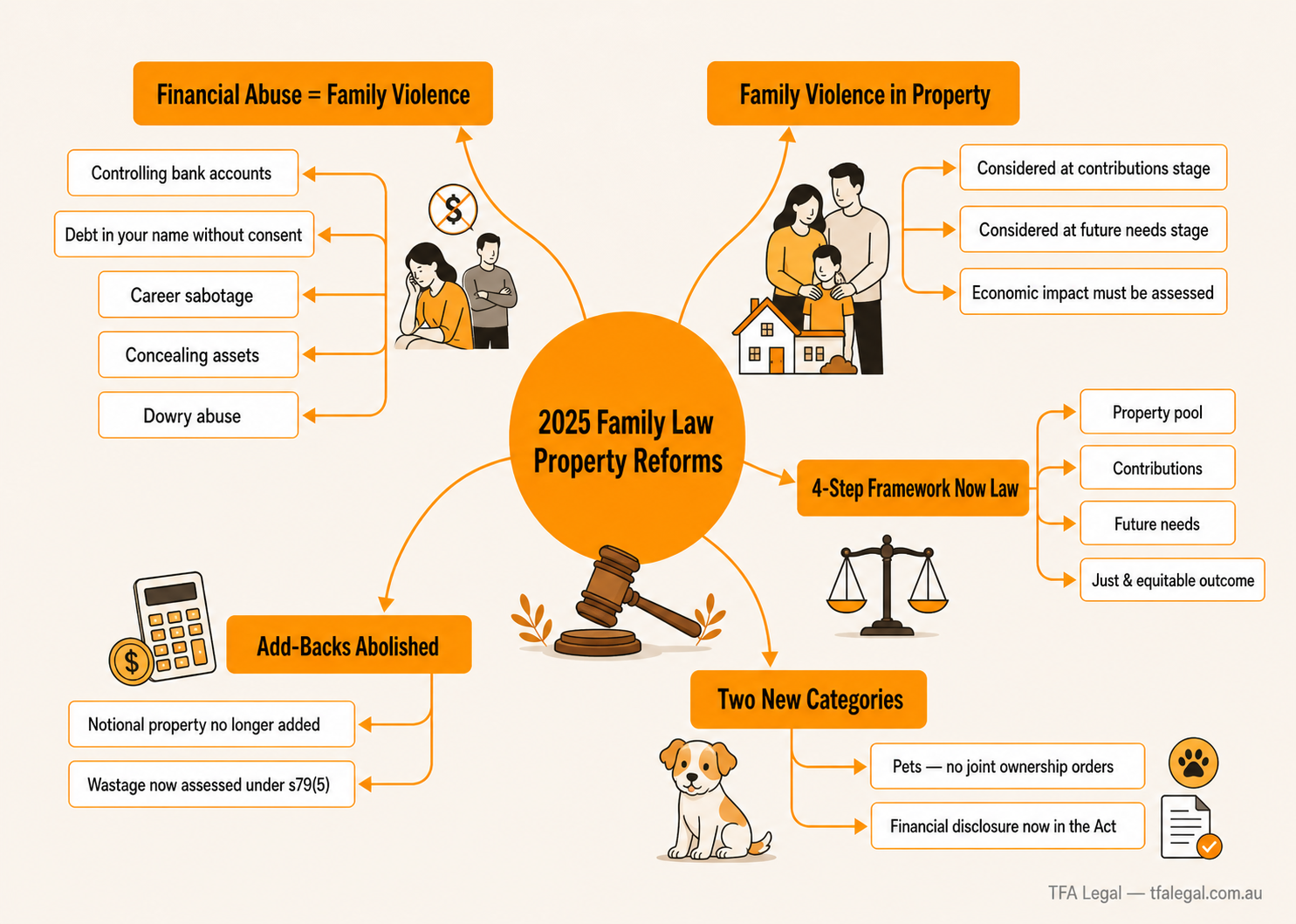
Step one requires the court to identify everything both parties own and owe: real estate, superannuation, investments, bank accounts, vehicles, businesses, and every debt attached to those assets. Under the amended Act, both parties are now subject to a statutory duty of full and frank financial disclosure — elevated from the Family Law Rules directly into the Act itself. This is no longer a procedural nicety. It is a legal obligation with consequences for those who breach it.
Step two requires the court to examine what each party contributed: financially through income, inheritances, and pre-relationship assets; non-financially through homemaking, parenting, and unpaid care work; and to the welfare of the family over time. This is where the most consequential change is embedded — the court must now also assess the effect of family violence on a party's ability to make those contributions.
Step three requires the court to consider each party's forward circumstances: age, health, income, earning capacity, care of children, and — again, for the first time in statute — the economic effect of any family violence experienced during the relationship.
Step four requires the court to make an order only if doing so is just and equitable, then structures the division of property to reach that outcome.
None of these steps are new in concept. What is new is that they are now law, not convention. That matters because it creates clearer grounds to challenge decisions that skip or misapply a step. It standardises how family violence must be considered — not as an optional factor a sympathetic judge might raise, but as a mandatory assessment at two separate points in the process. For most separating Australians, this codification means the framework is now predictable. For those who experienced abuse, it means the framework now has to see them.
Chapter 03
Financial Abuse Is Now Explicitly Family Violence
The abuse was effectively laundered out of the outcome. The perpetrator kept the gains. The survivor absorbed the loss. That framework is gone.
Naomi Pearce
This is the reform that matters most to the clients who walk through TFA Legal's door. The definition of family violence in section 4AB of the Family Law Act 1975 (Cth) has been expanded. Economic and financial abuse is now explicitly named in the statute — not implied, not read in by creative advocacy, but written into the definition.
Under the new section 4AB(2A), financial abuse can include: controlling or restricting a partner's access to money or bank accounts; accumulating debt in a partner's name without their knowledge or consent; concealing assets to disadvantage a partner in settlement negotiations; systematically sabotaging a partner's ability to maintain employment or income; and dowry abuse.
This matters because of what the 2025 property changes attach to it. Family violence is now embedded at two separate points in the property settlement assessment.
At step two — contributions — the court must consider the effect of family violence on a party's ability to make contributions to the property pool and the welfare of the family. If your partner controlled the finances throughout the relationship, your inability to build savings, develop your career, or accumulate assets in your own name was not a reflection of your effort or commitment. It was the direct consequence of abuse. Courts must now acknowledge that.
At step three — future circumstances — the court must consider the economic effect of family violence on a party's current and future circumstances. Credit damaged by debt your ex accumulated in your name. Career interrupted by years of coercive control. Mental health impacts that diminish your earning capacity going forward. These are economic consequences of the abuse — and they now factor into the settlement.
Before June 2025, the system created a cruel paradox: financial abuse often prevented survivors from making the contributions that courts rewarded. They arrived at property proceedings already behind — fewer assets in their name, less career progression, more debt — and the law had no mechanism to ask why.
In practical terms, this means that if you experienced financial control during your relationship, you now have a statutory basis to present evidence of that abuse in property proceedings — and to have a court quantify its economic effect. Bank records showing restricted access. Employment records showing career interruption that coincided with escalating control. Credit statements showing debt accrued in your name. Text messages documenting financial threats. These are no longer peripheral. Under the 2025 reforms, they are relevant to how your property is divided.
This is why TFA Legal integrates psychological wellbeing support with legal representation. Identifying financial abuse requires understanding what it looks like emotionally before you can see it on a bank statement. Our clients who have experienced financial control often do not initially name it as abuse — because they were told repeatedly that it was not. Our role is to help them see it, document it, and use it.
Chapter 04
Add-Backs Are Gone — And Courts Are Still Adjusting
If you have spoken to an Australian family lawyer in the past decade, you have likely heard the term "add-back." It referred to the mechanism where courts would notionally add money back into the property pool to account for one party's wasteful or reckless spending — gambling losses, deliberate dissipation of assets in anticipation of separation, reckless expenditure that reduced what was available to divide.
The Full Court has found that the 2025 family law property changes no longer permit notional property to be included in the pool for the purposes of section 79 of the Family Law Act 1975 (Cth). Add-backs, in their traditional form, are no longer available.
This is not as catastrophic as it sounds — but it requires careful navigation, and the courts are still working through the implications.
The amendments to section 79(5) introduce a set of new factors that can address many of the same situations add-backs were used for. The court can now consider the extent to which a party has wasted, destroyed, or recklessly dealt with property. It can consider whether that conduct has affected the other party's future circumstances. There is also a catch-all provision for other relevant matters. The conduct that previously justified an add-back can still be taken into account — it simply operates differently, as a factor in contributions and future needs rather than as a notional addition to the pool.
The practical consequence is this: if your ex spent, hid, or dissipated assets in the lead-up to separation, how your lawyer structures your case needs to reflect the new framework. Arguing add-backs in 2026 is arguing law that no longer exists. Make sure your legal representation is current.
Chapter 05
Companion Animals Now Have Their Own Legal Category
Among all the 2025 property changes, this is the reform that generated the most public interest — and while it might seem light relief after the financial abuse provisions, it is not a trivial amendment.
Before June 2025, pets were legally treated as property in Australian family proceedings. A dog was assessed like a dining table: owned by one party, assigned a value, allocated in the division. Courts could, in theory, order shared possession arrangements — which in practice either could not be enforced or became a mechanism for ongoing conflict between parties who were already struggling.
The amendments create a separate legal category for companion animals, defined as animals kept primarily for companionship. Two significant changes follow. First, courts are now explicitly prevented from ordering joint ownership or shared possession of a companion animal. Whoever receives the pet, receives them outright. The door to weaponising a shared-pet arrangement as ongoing leverage is closed.
Second, courts must weigh a specific list of considerations when allocating a companion animal: the circumstances of acquisition, which party has provided care and met the animal's needs, any history of family violence involving the animal, and the emotional attachment of any child to the animal.
That third consideration — family violence involving the animal — is significant. Threatening to harm a pet is a recognised form of coercive control. Pets are frequently used by perpetrators to maintain power over a partner after physical separation. The new framework allows that history to be considered when determining where the animal goes.
For many of our clients, the question of who keeps their dog or cat carries emotional weight far beyond any monetary value. Separation strips away so much that mattered. The law has finally acknowledged that these relationships deserve more than a line item on a balance sheet.
Chapter 06
Financial Disclosure Is Now a Statutory Obligation
This reform receives less attention than the family violence provisions, but its practical effect should not be underestimated.
Before 10 June 2025, the duty of full and frank financial disclosure — the obligation each party owes to tell the other everything relevant about their financial position — sat in the Federal Circuit and Family Court of Australia (Family Law) Rules. It was a procedural requirement, enforced through the court's procedural powers.
From 10 June 2025, that duty is in the Family Law Act 1975 (Cth) itself. The nature of the obligation has not changed. What has changed is its legal status — and therefore the seriousness with which courts can treat its breach.
Concealing assets, understating business income, failing to disclose a superannuation account or investment property are now violations of a statutory duty, not merely a departure from procedural expectations. For clients on the receiving end of a financially evasive partner — and this pattern appears consistently in relationships where financial control was already a dynamic — this change strengthens the legal foundation on which non-disclosure can be challenged and consequences pursued.
Chapter 07
What the 2025 Property Reforms Mean for You Right Now
If you are separating now and experienced financial abuse: the law has changed in your favour. At two points in the property assessment, what was done to you financially must now be considered. Do not assume your experience is too minor, too complicated, or too difficult to prove. Evidence that felt personal — bank statements, texts, employment records, debt documents — is now legally significant. Start gathering it early, before accounts are closed and records become harder to access.
If you are negotiating a settlement without going to court: the 2025 reforms apply to private negotiations as well as court proceedings. The standard your lawyer should be negotiating toward is what a court would now award — which means the economic effect of any family violence should be part of the conversation, even if you never file proceedings.
If your case was already underway on 10 June 2025: the amendments apply to existing proceedings unless your case had already reached a final hearing. It is worth speaking to your lawyer specifically about whether the new framework changes the approach to your matter. In many cases, it does.
If you were counting on add-backs to address your ex's financial misconduct: the legal mechanism has changed. How your case now accounts for wasted or dissipated assets needs to be restructured to reflect the new framework under section 79(5). Review this with your lawyer as a priority.
If you signed a financial agreement before June 2025: the reforms do not retrospectively alter the terms of a Binding Financial Agreement already in place. However, if that agreement was made under circumstances involving financial abuse or coercion, there are separate grounds to have it set aside — and those grounds have not changed.
Chapter 08
Why These Reforms Matter Beyond the Law
In the months since June 2025, something has shifted in the conversations we have at TFA Legal. Clients who experienced financial abuse during their relationship are arriving at initial consultations differently. Some have read about the reforms. Some were told about them by a counsellor or a friend. Almost all of them ask the same question.
Does this mean what I think it means? Does what happened to me finally count for something?
The answer, with appropriate caveats about individual circumstances, is: more than it ever has before.
But legal recognition does not make a property settlement easy to navigate. The clients who arrive having experienced financial abuse are often the same clients who have difficulty accessing their own financial records, whose confidence has been systematically dismantled, who do not fully trust their own recollection of events because they were told repeatedly that their memory was wrong.
The 2025 reforms change what courts must consider. They do not change what clients must still live through to get there. This is why integrating psychological wellbeing support with legal representation is not an optional extra at TFA Legal — it is a legal strategy. Clients who are emotionally supported gather better evidence, make clearer decisions under pressure, and present more effectively throughout the legal process.
The reforms have made financial abuse legally visible. Our job is to help clients see it clearly enough to use it. If your separation involved financial control, hidden assets, career sabotage, or debt accumulated in your name — call our office. Not for a sales pitch. For a conversation that takes what happened to you as seriously as the law now does.
Appendix
Frequently Asked Questions
About the Author
Naomi Pearce
Senior Partner & Founder
LIV Accredited Specialist in Family Law, admitted in Victoria and Queensland. Naomi specialises in trauma-informed family violence representation and coercive control litigation.