

Chapter 01
What Most Explanations Get Wrong
Child support in Australia is one of the most searched family law topics online, and one of the most poorly explained. Most of what circulates in forums and family group chats is wrong, incomplete, or based on how the system worked before significant reforms. Parents make decisions based on it anyway, and those decisions cost them.
This article is an attempt to explain child support in Australia the way a good lawyer would explain it to you in person: clearly, specifically, and without the hedging that turns legal information into something useless.
The starting point is this. Child support in Australia is not a negotiation. It is a formula. The formula is set out in the Child Support (Assessment) Act 1989 (Cth) and administered by Services Australia. It takes specific inputs and produces a specific output. If you understand the inputs, you can understand the output, and you can start to understand whether the assessment you received is correct.
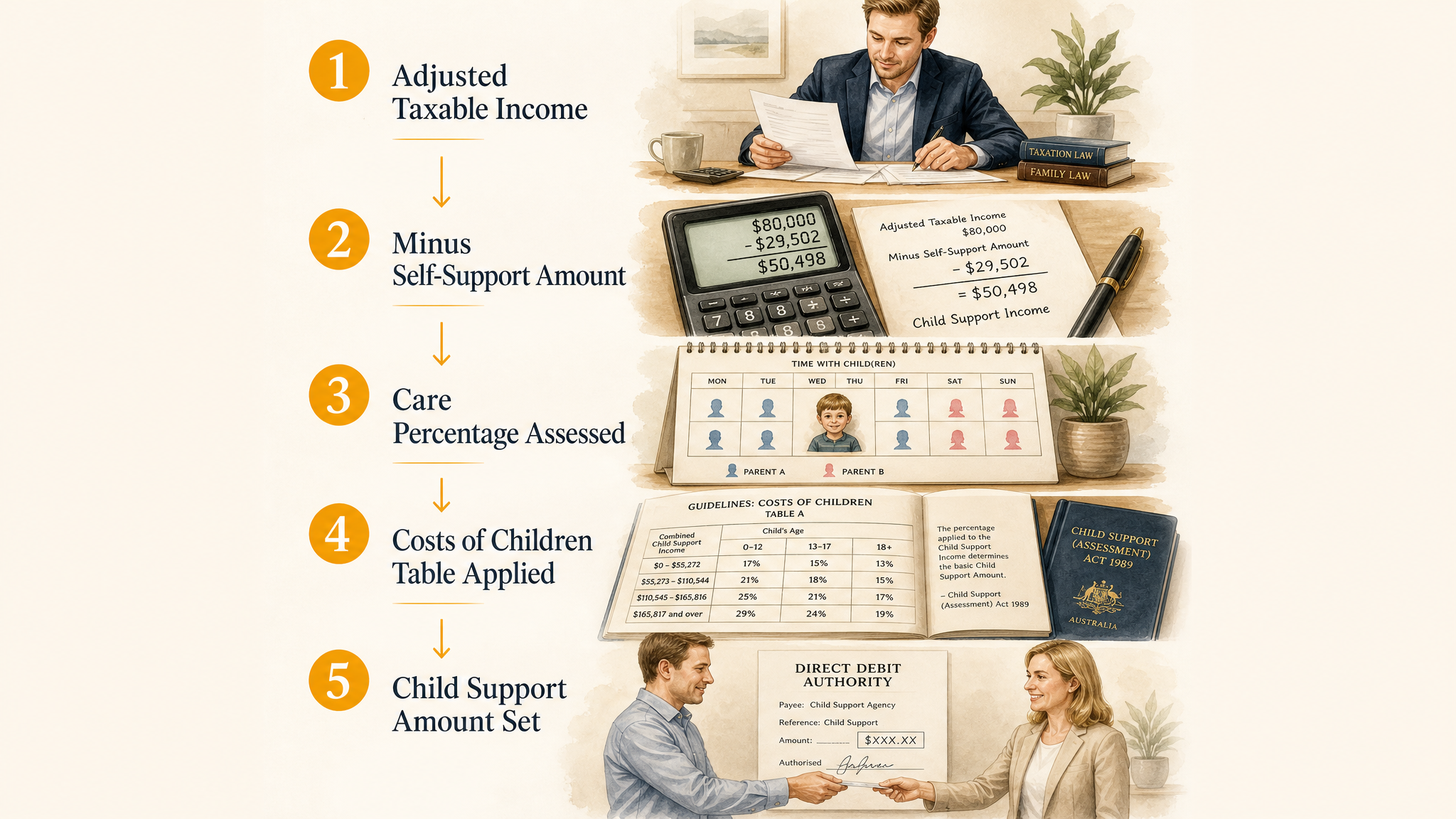
The formula has eight steps. Each one builds on the last. Here is how each step works.
Chapter 02
Step 1: Each Parent's Income Is Identified
The formula starts with what Services Australia calls the "adjusted taxable income" of each parent. This is not necessarily the same as the income figure on your tax return, though it is usually close.
Adjusted taxable income includes taxable income, reportable fringe benefits, total net investment losses, and reportable employer super contributions. It also includes certain trust distributions and the deemed income from a private company if the parent is a director or shareholder and Services Australia considers the company is being used to shelter income.
This last point matters more than most parents realise. A parent who structures their earnings through a company to reduce their visible taxable income does not automatically reduce their child support assessment. Services Australia has the power to attribute income from private companies and trusts where it is satisfied that income is being sheltered. A Change of Assessment application is available to address this specifically.
Where a parent's income in the most recent tax year is not yet assessed, Services Australia will use either a self-declared income estimate or the income from the previous year. Deliberately under-declaring income is a common tactic. It is also a ground for Change of Assessment.
Chapter 03
Step 2: The Self-Support Amount Is Deducted
Before anything else is calculated, Services Australia deducts what is called the self-support amount from each parent's income. In 2026, that amount is $31,046.
The self-support amount represents the threshold below which a parent is not expected to contribute financially to child support. It is intended to protect each parent's basic living costs. If a parent earns less than the self-support amount, their child support income is treated as nil for the purposes of the formula.
Think of it this way. The formula is not asking each parent to contribute everything they earn. It is asking each parent to contribute from the income they have available after covering their own basic needs. The self-support amount is the law's acknowledgement that a parent who cannot support themselves cannot meaningfully support their children financially either.
After deducting the self-support amount, you are left with each parent's "child support income." This figure feeds into the next stage of the calculation.
Chapter 04
Step 3: The Combined Income Is Calculated
Services Australia adds the two child support incomes together to produce the "combined child support income." This combined figure determines how much it is estimated to cost to raise the children at that household income level.
The cost of children figures are taken from an annually adjusted schedule. The schedule provides a dollar amount that represents the estimated cost of raising a specific number of children, at the combined income level. The figures increase as income increases, reflecting the reality that higher-income families spend more on their children.
This is where a common misunderstanding arises. The formula does not ask each parent to pay half the cost of children. It asks each parent to contribute a proportion of that cost that reflects their share of the combined income and their level of care. Those are two different things, and the distinction matters significantly when incomes are unequal or care is shared.
Chapter 05
Steps 4 and 5: Income Shares and Care Percentages
Step 4 is straightforward. Services Australia calculates what percentage of the combined child support income each parent contributes. If Parent A earns $60,000 after the self-support deduction and Parent B earns $40,000, Parent A holds 60 per cent of the combined income and Parent B holds 40 per cent.
Step 5 introduces care percentage, which is where the formula becomes most sensitive to individual circumstances.
Care percentage is the proportion of nights per year each parent has the child in their care, expressed as a percentage. Five levels of care are recognised under the Act.
Below regular care: 0 to 13 per cent of nights (fewer than 52 nights per year). The parent at this level is treated as contributing nothing to the direct costs of care.
Regular care: 14 to 34 per cent of nights (52 to 127 nights per year). The parent at this level is credited with contributing 24 per cent of the cost of children.
Shared care: 35 to 47 per cent of nights. Credited with 25 per cent plus 2 per cent for each percentage point of care above 35 per cent.
Shared care (above half): 48 to 52 per cent of nights. The care credit is calculated differently at this band as the arrangement approaches equality.
Primary care: 53 to 65 per cent of nights. Credited with 76 per cent of the cost of children.
Above primary care: more than 65 per cent of nights (more than 237 nights per year). Credited with 100 per cent of the cost of children.
The parent who provides more than 65 per cent of care is almost always the one who receives child support rather than pays it, regardless of income. This is the threshold that parents in disputed parenting proceedings most often argue about, because the financial consequences of crossing it are significant.
Chapter 06
Steps 6, 7, and 8: Calculating the Amount
Once the income percentages and the care cost percentages are established, the formula calculates each parent's "child support percentage." This is the income share percentage minus the cost percentage. If Parent A's income share is 60 per cent and their care cost percentage is 24 per cent, their child support percentage is 36 per cent.
That child support percentage is then applied to the annual cost of children figure to produce the annual child support payable. Services Australia converts this to a monthly figure for the administrative assessment.
If the child support percentage is positive, the parent pays. If it is negative, the parent receives. If it is very close to nil, the assessment may produce a zero result, meaning neither parent pays the other anything under the formula.
The minimum annual child support amount in 2026 is $551. If the formula would otherwise produce a lower figure, the paying parent is assessed at the minimum unless they qualify for a reduced assessment on the basis of low income.
There is also a maximum. The income cap for child support purposes in 2026 is $163,446 of adjusted taxable income. A parent earning above the cap is assessed as if they earn at the cap. If one parent genuinely earns significantly more than the cap and believes the standard assessment does not reflect the children's actual costs, a Change of Assessment is available to address this.
Chapter 07
The Five Things Most Parents Get Wrong
First, people assume child support is negotiable between parents. It is not. Parents can enter into a private child support agreement that is binding and registered with Services Australia, or they can accept the administrative assessment. But neither party can simply agree to pay less than the formula produces and have that arrangement enforced. An unregistered private agreement gives the receiving parent no enforcement mechanism.
Second, people underestimate the impact of income changes. Child support assessments are reviewed annually when tax returns are lodged. If your income changes significantly during the year, you can apply for an income estimate to adjust the assessment immediately. Waiting for the annual review when your income has dropped substantially means overpaying for months.
Third, people misunderstand how care percentage is counted. Care is counted in nights, not hours. A parent who has a child from Friday afternoon to Monday morning has three nights of care for that weekend, not "a weekend." The difference across a year can shift the care percentage across one of the thresholds described above, with significant financial consequences.
Fourth, people do not challenge assessments they believe are wrong. A Change of Assessment is available where the standard assessment would produce a result that is "unjust and inequitable" in the specific circumstances. The grounds include a parent's income not accurately reflecting their earning capacity, a significant change in either parent's costs, the child having special needs, and a parent deliberately reducing their income to reduce their assessment.
Fifth, people assume child support covers everything. It does not. Child support is intended to cover the everyday costs of raising children: food, clothing, shelter, and ordinary expenses. Costs like private school fees, extracurricular activities, medical expenses not covered by Medicare, and significant one-off costs are not covered by the standard assessment. These are typically negotiated separately and can become a source of significant conflict if they are not addressed in a parenting plan or court order.
Chapter 08
When the Formula Does Not Apply
The administrative assessment is the default. But it is not the final word.
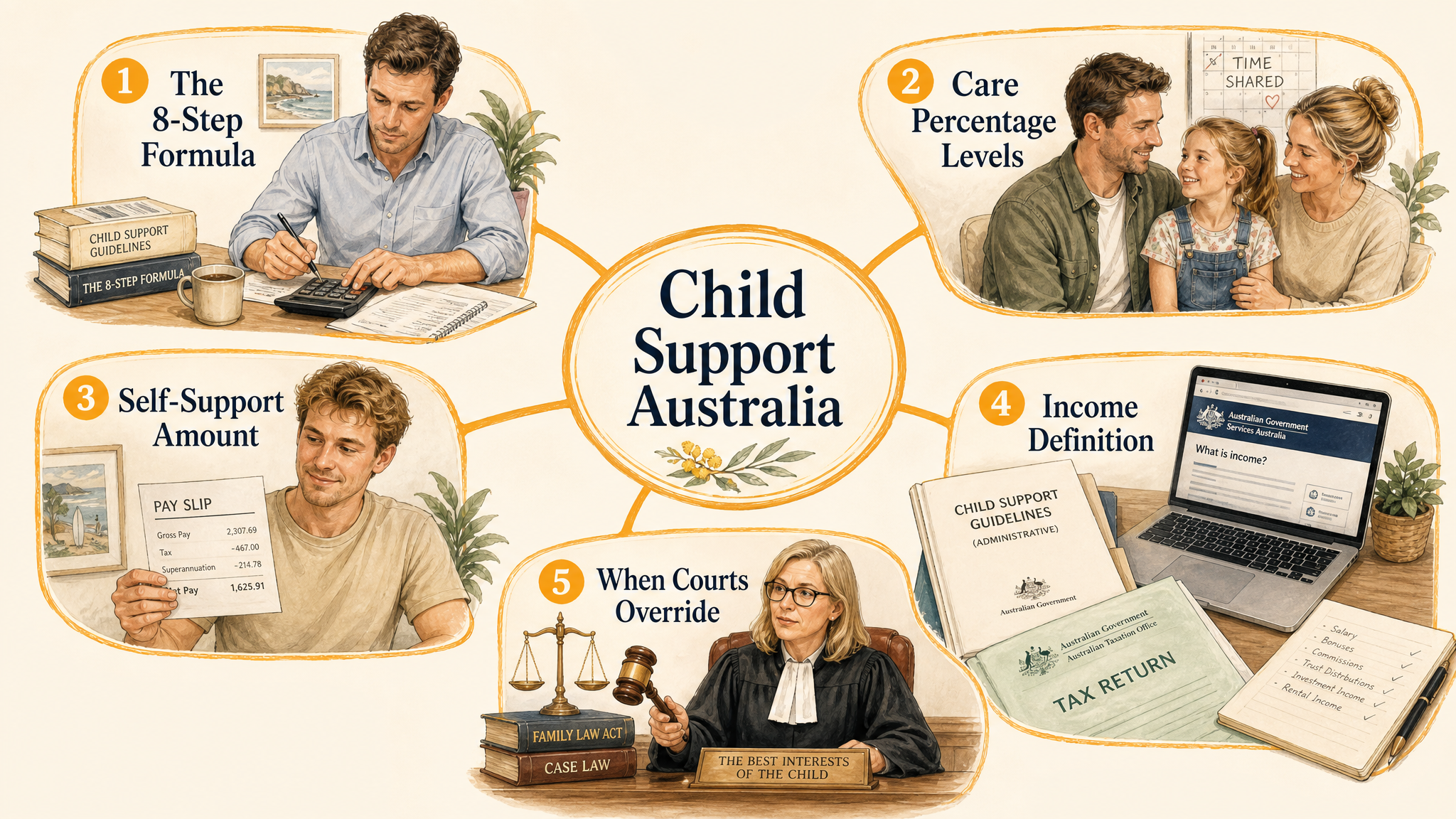
A Change of Assessment is an administrative process within Services Australia that allows either parent to argue that the standard formula produces an unjust result in their specific circumstances. The grounds are listed in s 98C of the Child Support (Assessment) Act 1989 (Cth) and include factors that the formula does not capture: the cost of maintaining contact with a child, the income, earning capacity, property, and financial resources of either parent, the special needs of the child, and the financial circumstances of any new partner.
If a Change of Assessment is refused or if either parent is dissatisfied with the outcome, the matter can be reviewed by the Administrative Appeals Tribunal and, ultimately, by the Federal Circuit and Family Court of Australia.
The court also has the power to make orders outside the formula entirely under s 66J of the Family Law Act 1975 (Cth). This is most commonly used in cases involving very high-income parents where the capped formula does not reflect the children's actual standard of living, or in cases where special circumstances make the standard approach inappropriate.
Finally, parents can enter into a Limited Child Support Agreement or a Binding Child Support Agreement. A Limited Agreement must reflect at least the assessed amount and can be entered into without independent legal advice, but it terminates automatically in certain circumstances. A Binding Agreement can set an amount that is above or below the assessed amount, but both parties must receive independent legal advice before signing, and the agreement must be in a prescribed form.
Chapter 09
What Child Support in Australia Is Really About
The formula is a mechanism. What makes child support contentious is rarely the numbers themselves. It is everything the numbers represent.
Naomi Pearce
The formula is a mechanism. It is designed to produce a consistent, objective starting point for what each parent contributes to the financial cost of raising their children after separation. It does this reasonably well in straightforward cases.
What it does not do is resolve the underlying tension that makes child support so contentious. That tension is not really about money. It is about the unequal distribution of parenting responsibilities after separation, the way income and care are intertwined, and the way financial arrangements can become a proxy for everything else that has gone wrong in a relationship.
At TFA Legal, we work with parents at every stage of this process: challenging assessments that do not reflect the real picture, negotiating private agreements that actually hold, and representing clients in Change of Assessment proceedings when the formula produces outcomes that are genuinely unjust. We also work with clients to understand that child support is not the same as the broader financial relationship between separated parents, and that getting clarity on both is how you actually move forward.
If you have received a child support assessment for Australia that does not seem right, or you are about to enter the system and want to understand what to expect, the first step is a conversation. Call us on 1300 322 295 or book a free consultation at tfalegal.com.au.
Appendix
Frequently Asked Questions
About the Author
Naomi Pearce
Senior Partner & Founder
LIV Accredited Specialist in Family Law, admitted in Victoria and Queensland. Naomi specialises in trauma-informed family violence representation and coercive control litigation.